The BREATHE Index
"If leaders would learn anything from the past many years, it's that there are no quick fixes. For most organizations, meaningful change is at least a three- to five-year process — though this seems impossibly long. Yet multiyear change efforts are the hard reality we must face."
– Margaret Wheatley
B.R.E.A.T.H.E. - Buildings, Retail, Energy, Agriculture,Transport, Homes, Education.
Greenhouse Gas emissions are a major contributor to global climate change and require cross sector solutions in order to be significantly reduced. If we all do more, no one sector has to carry the burden for us all.
B.R.E.A.T.H.E. is the Green Offaly Index that we are creating for ease of approach when it comes to measuring Greenhouses Gases across the varying Sectors in Offaly. The index will also enable us to focus on one Sector at a time which will help to break down this enormous task into a more manageable and less daunting task!
BREATHE will provide a snapshot of where we are starting from and enable us to measure progress in reducing GHGs in real time. It will consist of 8 continually updated visual representations of GHG emissions, one for each sector and one for total emissions for the County as a whole.
Transitioning to a sustainable future is like unravelling a gigantic, tangled ball of wool. It will take patience, time and methodology and we will get frustrated that we can’t get there as quickly as we would like!
The BREATHE Areas
1. Buildings
Buildings in this sense refers to all Buildings other than our Homes and Schools. Buildings that we use as a Community – your local Library, Community Centre, Leisure Centre, Hospital, Garda Station all come under this category.
The buildings which house these sectors are a mixed bag. Some are old stone buildings, others are Georgian, many are mid century builds and a few are modern. We will be measuring the emissions coming from this sector specific public building stock and looking at ways in which we can begin to reduce emissions from these. It is going to take time but we will get there!
"Smile, breathe and go slowly."
– Thich Nhat Hanh
2. Retail
The retail sector is Ireland’s largest private sector employer. It employs over 280,000 people, in every city, town and village, right across the country. As such, retail plays a crucial role in stimulating economic growth and enterprise, sustaining employment and supporting lively and vibrant communities across Ireland.
Retail in Offaly covers a whole wealth of local, national and internationally owned Businesses including supermarkets; department stores; pharmacies; hardware stores, home and electrical outlets; clothing stores, footwear and luxury goods brands; charity shops; shopping centres; convenience stores; service stations; specialist outlets; and local, independent operators.
Retail is a vital sector to address from both an emissions and a Community regeneration point of view. A vibrant retail sector is vital to the long term financial health of our Communities however, like all things, the face of our Main streets is changing. As online sales increase year on year, many of our local shops and main streets are struggling.
A sustainable future for Offaly means that not only do we have to lower emissions from the buildings that house retail and the products that are sold BUT we also have to reimagine how our main streets can survive.
‘Shop Local’ is not just good for Offaly Retailers, it is vital in driving down our CO2 emissions and ensuring that the things we buy are responsibly produced and good for our health.
‘We need to start to recognise that to be truly sustainable, many key societal needs will have to be met through a service model, providing access rather than ownership, and that access will need to be universal. It will only be through these service models that we will enable consumers to reduce their demand for resources and help them easily reduce their own personal material consumption.’
What that means for developers and retail space owners is that they need to start asking themselves the really difficult question: ‘Does this retail development help customers and residents to lead better, healthier more sustainable lives?’ Because if the answer is no, then it really shouldn’t be part of the offer’. – Claire Brady, bioregional.com
GreenBusiness, in conjunction with the Environmental Protection Agency, has prepared a useful set of guidelines dedicated to helping retail businesses reduce their costs, better manage their waste and limit their environmental footprint. The guidelines are warmly supported by Retail Ireland.
The guidelines provide Irish retailers with the information, guidance and tips needed to reduce business costs by making small changes to how resources are managed, thereby also enhancing the green credentials of the retail industry.
The guide is aimed at all retailers, from large corporate chains to small independent stores, and is an invaluable resource in advising businesses how to reduce their energy, water and waste bills.
You can download a copy of the guidelines and a helpful accompanying wall chart below.
Resources
Low Carbon Pledge Report PDF by Business In The Community Ireland
Sustainable ideas for businesses by DoNation
3. Energy, Agriculture & Transport
As we have gone into these sectors in more detail in previous sections we ask you to refer back to our Changing Climate Section and Sustainable Communities Section. The diagrams below give you the overall picture!
Three Decades of GHG Emissions in Ireland


4. Homes
There are all different types and ages of home buildings in Offaly, from Old Stone, to Georgian Town Houses to mid century bungalows, right up to modern day apartments; our building stock is as diverse as our Communities.
When it comes to converting these buildings over to low emitters of CO2 there are as many questions as there are solutions.
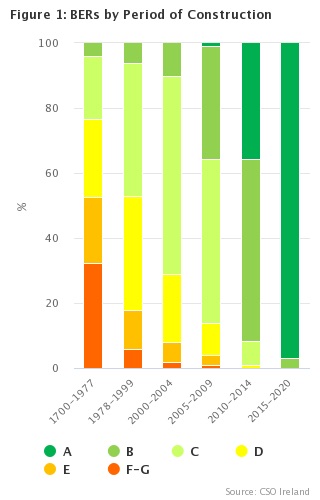
As a Rural County we are at a distinct disadvantage when it comes to energy efficiency in our building stock. The average household in cities such as Dublin spend hundreds of euros less on home heating than the average Midlands Home. It all comes down to the BER (Building Energy Rating). The older the home, the higher the rating, the higher the energy bill.

Only 10% of Offaly's Buildings have a BER rating of A or B
This rating scale translates to an average yearly energy bill of €190 per year in A-rated buildings compared with a whopping €4,000 per year in G-rated buildings.
There are many of us who simply can’t afford to make the improvements needed to bring our homes up to a BER A or B grade efficiency. Supports are available for homeowners (see SEAI) but like elsewhere in the country, renters are faced with owners who are not willing to upgrade homes. With the rising Carbon Tax on Fossil based fuels this is an inequality which needs to be addressed by the government if the entire building stock is going to be retrofitted.
At Green Offaly we will be compiling an inventory of Home Energy Use across the County and looking at how we can address this issue in a way that gives every household equal access to a warm, low energy home. This will be done in line with our Sustainable Planning Initiative for each main Community. Change won’t happen overnight but it does have to happen at some point in the next 10 years, if the government is going to make good on its zero net emissions by 2050 ambition.
Find out more from SEAI here.
5. Education
At Green Offaly we believe that our Schools should be a priority when it comes to decarbonisation. Our children have a great understanding of green issues due to their participation in the excellent Green Schools Programmes operated by An Taisce. It would be great to be able to back this learning up (especially in regard to the Energy Theme), with the practical installation of renewable energy systems in Schools. In addition to this, the money that Schools have to spend each year on oil fired central heating is astronomical. This money could be put to much better use by buying equipment and books!